25 Feb 2026
VistaShares Making Weekly Distribution For BitBonds™ 5 Yr Enhanced Weekly Option Income ETF (BTYB)
April 10, 2026 Declaration Date – NEW YORK & SAN FRANCISCO & BOSTON – VistaShares, an innovative asset manager seeking to disrupt the status quo in thematic exposures, income investing, and more, is today announcing the next weekly distribution amounts for its new fund, BitBonds™ 5 Yr Enhanced Weekly Option Income ETF (BTYB).
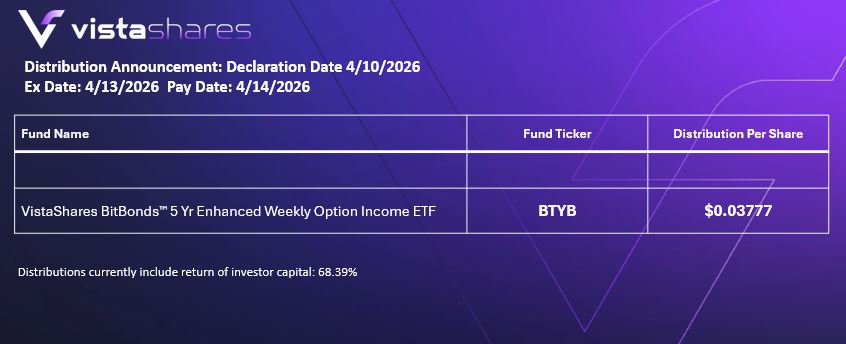
Distributions for BTYB currently may include a return of investor capital. This Week’s ROC: 68.39% for payable date April 14, 2026. Returns of capital would decrease the Fund’s NAV and trading price over time. As a result, an investor may suffer significant losses to their investment.
Constructed like no other ETF on the market, BTYB’s underlying portfolio is designed so 80% of the fund’s holdings are in U.S. Treasury securities, U.S. Treasury Futures, and treasury-focused ETFs with target maturities between three and seven years. The remaining 20% of BTYB’s portfolio provides exposure to the price movements of Bitcoin via a synthetic covered call strategy.
BTYB’s actively managed options strategy employs a goal of delivering twice the annual yield of the 5-year Treasury. Distributions aim to be made on a weekly basis.
For more information and updates from VistaShares ETFs, please visit www.VistaShares.com and follow the firm on LinkedIn @VistaShares, and on X @VistaSharesX.
About VistaShares
At VistaShares, we strive to deliver innovative investment solutions for today’s investors, helping them navigate evolving market opportunities with confidence. VistaShares ETFs are actively managed by industry and investment experts, offering two distinct strategies. Our Pure Exposure™ ETFs target technology-driven economic Supercycles® that we believe are poised for significant growth. Additionally, our Target 15™ option-based income ETFs are designed to generate high monthly income while complementing a core equity portfolio.
—
Important Information:
VistaShares BitBonds™ 5 Yr Enhanced Weekly Option Income ETF (BTYB)
Although Bitcoin may be referred to as a “cryptocurrency” it is not yet widely accepted as a means of payment.
The Fund does not invest directly in Bitcoin or any other digital assets. The Fund does not invest directly in derivatives to track the performance of Bitcoin or any other digital assets. The Fund does not invest in or seek direct exposure to the current “spot” or cash price of Bitcoin. Investors seeking direct exposure to the price of Bitcoin should consider an investment other than the Fund.
Digital Assets Risk: Digital assets like Bitcoin, designed as mediums of exchange, are still an emerging asset class. They operate independently of any central authority or government backing and are subject to regulatory changes and extreme price volatility. The trading platforms for digital assets are relatively new, largely unregulated, and thus more vulnerable to fraud and failures compared to traditional, regulated exchanges. Shutdowns of these platforms due to fraud, technical glitches, or security issues can significantly affect digital asset prices and market volatility.
Digital Asset Markets Risk: The digital asset market, particularly Bitcoin, has experienced considerable volatility, leading to market disruptions and erosion of confidence among market participants. This instability and the resultant negative publicity could adversely affect the Fund’s reputation and trading prices. Ongoing market turbulence could significantly impact the value of the Fund’s share.
Blockchain Technology Risk: Blockchain technology, which underpins Bitcoin and other digital assets, is relatively new, and many of its applications are untested. The adoption of blockchain and the development of competing platforms or technologies could affect its usage. Investments in companies or vehicles that utilize blockchain technology are subject to market volatility and may experience lower trading volumes compared to more established industries. Additionally, regulatory changes, internet disruptions, cybersecurity incidents, and intellectual property disputes could further affect the adoption and functionality of blockchain technology.
Interest Rate Risk. Generally, the value of fixed income securities will change inversely with changes in interest rates. As interest rates rise, the market value of fixed income securities tends to decrease. Conversely, as interest rates fall, the market value of fixed income securities tends to increase. This risk will be greater for long-term securities than for short-term securities. In addition, the interest rates payable on floating rate securities are not fixed and may fluctuate based upon changes in market rates. The interest rate on a floating rate security is a variable rate which is tied to another interest rate. Floating rate securities are subject to interest rate risk and credit risk.
U.S. Government and U.S. Agency Obligations Risk. The Fund may invest in securities issued by the U.S. government or its agencies or instrumentalities. U.S. Government obligations include securities issued or guaranteed as to principal and interest by the U.S. Government, its agencies or instrumentalities, such as the U.S. Treasury. Payment of principal and interest on U.S. Government obligations may be backed by the full faith and credit of the United States or may be backed solely by the issuing or guaranteeing agency or instrumentality itself. In the latter case, the investor must look principally to the agency or instrumentality issuing or guaranteeing the obligation for ultimate repayment, which agency or instrumentality may be privately owned. There can be no assurance that the U.S. Government would provide financial support to its agencies or instrumentalities (including government-sponsored enterprises) where it is not obligated to do so.
Credit Risk. Bonds are subject to credit risk. Credit risk refers to the possibility that the issuer or guarantor of a security will be unable and/or unwilling to make timely interest payments and/or repay the principal on its debt or to otherwise honor its obligations and/or default completely. Bonds are subject to varying degrees of credit risk, depending on the issuer’s financial condition and on the terms of the securities, which may be reflected in credit ratings. There is a possibility that the credit rating of a bond may be downgraded after purchase or the perception of an issuer’s credit worthiness may decline, which may adversely affect the value of the security.
Fixed Income Risk. The prices of fixed income securities respond to economic developments, particularly interest rate changes, as well as to changes in an issuer’s credit rating or market perceptions about the creditworthiness of an issuer. In general, the market price of fixed income securities with longer maturities will increase or decrease more in response to changes in interest rates than shorter-term securities. Changes in government intervention may have adverse effects on investments, volatility, and illiquidity in debt markets. These changes could cause the Fund’s net asset value to fluctuate or make it more difficult for the Fund to accurately value its securities. How specific fixed income securities may react to changes in interest rates will depend on the specific characteristics of each security.
ETP Risks. Investing in exchange-traded products (ETPs) that focus on commodities and currencies carries a variety of risks. Market risk is a primary concern, as the value of these investments can fluctuate significantly due to changes in market conditions influenced by global economic shifts, market sentiment, and geopolitical events. Particularly with commodities, investors face heightened volatility. This can be attributed to a range of factors, including changes in overall market movements, specific industry impacts, natural disasters, and regulatory changes. Currency investments in ETPs are equally subject to the volatility of global currency markets, influenced by fluctuating exchange rates, national economic policies, inflation, and political instability.
Underlying Bitcoin ETP Risks: Investing in an Underlying ETP that focuses on Bitcoin, either through direct holdings or indirectly via derivatives like futures contracts, carries significant risks. These risks include high market volatility, which can be influenced by technological advancements, regulatory changes, and broader economic factors.
High Portfolio Turnover Risk. The Fund’s at least monthly reallocation of its portfolio holdings to seek to maintain a balanced notional exposure of approximately 80% of the Fund’s total assets to the U.S. Treasuries Allocation and 20% of the Fund’s total assets to the Bitcoin Related Allocation, as well active and frequent trading of a portion of the Fund’s holdings, may result in high portfolio turnover.
Derivatives Risk. Derivatives are financial instruments that derive value from the underlying reference asset or assets, such as stocks, bonds, or funds (including ETFs), interest rates or indexes.
Options Contracts. The use of options contracts involves investment strategies and risks different from those associated with ordinary portfolio securities transactions. The prices of options are volatile and are influenced by, among other things, actual and anticipated changes in the value of the underlying instrument, including the anticipated volatility, which are affected by fiscal and monetary policies and by national and international political, changes in the actual or implied volatility or the reference asset, the time remaining until the expiration of the option contract and economic events.
Weekly Income Disclosure: There is no guarantee of how the Fund will perform in the future. There is no assurance the Fund will make a distribution in any given week or month and the following may vary greatly.
30-Day SEC Yield: The 30-Day SEC Yield represents net investment income, which excludes option income, earned by the Fund over the 30-Day period ended at the most recent month-end, expressed as an annual percentage rate based on the Fund’s share price at the end of the 30-Day period.
Distribution Rate: The annual rate an investor would receive if the most recent fund distribution remained the same going forward. The Distribution Rate represents a single weekly distribution from the Fund and is not a representation of the Fund’s total return. The Distribution Rate is calculated by multiplying the most recent distribution by 52 in order to annualize it, and then dividing by the Fund’s NAV.
New Fund Risk: The Fund is a recently organized management investment company with no operating history. As a result, prospective investors do not have an extensive track record or history on which to base their investment decisions.
Liquidity Risk. Some securities held by the Fund, including options contracts, may be difficult to sell or be illiquid, particularly during times of market turmoil.
The Fund may not achieve its investment objective and there is a risk that you could lose all of your money invested in the Fund. By writing covered calls the Fund may limit its potential gains in exchange for premium income.
Foreside Fund Services, LLC, distributor