07 Jul 2026
VistaShares Surpasses $2 Billion in Assets
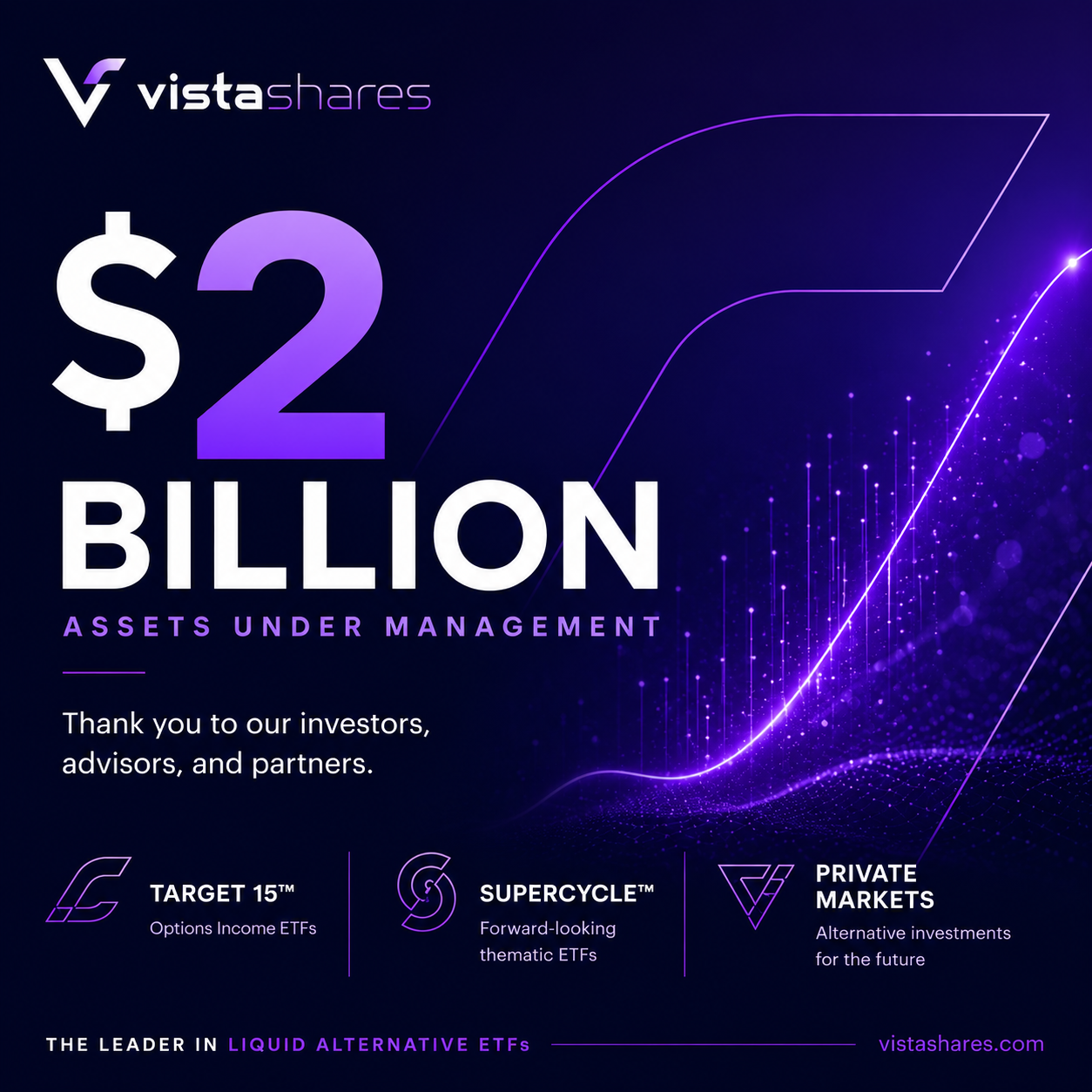
Investors have been drawn to the “Bill of Materials” approach underpinning the firm’s thematic ETF offerings and the ways in which their “Legends + Income” funds allow them to invest like the best while generating attractive yields
BOSTON & SAN FRANCISCO (July 7, 2026) – VistaShares, a leading issuer of ETFs designed to upend the status quo in thematic investing, income investing and more, today announced that the firm has passed $2 billion in assets under management just a few short months after reaching the $1 billion mark.
“This is the kind of acceleration my colleagues and I have been working towards since VistaShares was just an idea,” said Adam Patti, CEO of VistaShares. VistaShares develops research-driven investment strategies designed to help investors access opportunities that have historically been difficult to capture through traditional investment vehicles. The firm’s approach combines its rigorous patent-pending methodology with the active oversight of industry leaders, leveraging their in-depth knowledge to identify what they believe are the hidden opportunities in the global markets.
That leadership team combines deep experience across finance and technology and includes Patti, who has decades of experience building and growing ETF lineups and co-founder Jon McNeill, co-founder of DVx Ventures and former President of Tesla. Both are part of an investment committee that also includes Robert Whitelaw, former Dean of NYU Stern Undergraduate College; David Fetherstonhaugh, formerly of Peter Thiel’s Mithril Capital; Sunny Madra, former President of Groq; Justin Lopas, Co-Founder of Base Power, and Ian Cinnamon, Co-Founder and CEO of Apex Space.
Central to the firm’s growth has been its patent-pending “Bill of Materials” approach, which seeks to identify where capital is actually being deployed across transformative industries and is informed by direct input from the experts operating within those sectors. This approach has distinguished the firm and contributed to the growth of its funds like the VistaShares Artificial Intelligence Supercycle® ETF (AIS), which is fast approaching $1 billion in assets in its own right.
The firms Supercycle® ETFs lineup also includes the VistaShares Electrification Supercycle® ETF (POW), which provides exposure to the companies behind today’s surge in the grid capex.
“Areas like AI and power move quickly and by staying close to the people building the new technologies and businesses, we are able to construct portfolios based on where capital is flowing, instead of where it has been,” added Patti. “We’re also not constrained by rigid benchmarks that are too often still tracking a theme as it may have appeared years ago. Investors need to look forward, not backward, and that’s what our ETFs allow them to do.”
In addition to its thematic ETF offerings, VistaShares has continued to expand its “Legends + Income” suite, which seeks to provide investors with exposure to the equity portfolios of what we believe to be the some of the world’s greatest investors while striving to generate attractive potential income.
The flagship fund in that suite, the VistaShares Target 15™ Berkshire Select Income ETF (OMAH), provides investors an opportunity to invest like Berkshire Hathaway, but with the addition of an options-overlay strategy that targets 15% annual income, paid monthly. The lineup has since expanded to include funds delivering similar equity + income exposure to the portfolios of Bill Ackman and Pershing Square (ACKY), Stanley Druckenmiller and the Duquesne Family Office (DRKY), and David Tepper’s Appaloosa Management, L.P. (TPRY).
“We are excited about where we can go from here,” added Patti. “The foundation we have built allows us to continue expanding with useful solutions unlike any others that ETF investors have been able to access to this point.”
For more information and updates from VistaShares, please visit www.VistaShares.com and follow the firm on LinkedIn @VistaShares, and on X @VistaSharesX.
About VistaShares
VistaShares, the leader in Liquid Alternative ETFs, strives to deliver innovative investment solutions for today’s investors, helping them navigate evolving market opportunities with confidence. VistaShares ETFs are actively managed by industry and investment experts, offering a number of distinct strategies. Supercycle® Growth Equity ETFs target technology-driven economic Supercycles® that we believe are poised for significant growth, while Target 15 ™option-income ETFs are designed
to generate high monthly income while complementing a core equity portfolio.
Investors should consider the investment objectives, risks, charges and expenses carefully before investing. For a prospectus or summary prospectus with this and other information about the Fund,
please call (844) 875-2288. Read the prospectus or summary prospectus carefully before investing.
Investing involves risk, including possible loss of principal.
There is no guarantee of how the Fund will perform in the future. There is no assurance the Fund willmake a distribution in any given month and the following may vary greatly.
Important Information:
Focused Portfolio Risk. The Funds may hold a relatively focused portfolio that may contain exposure to the securities of fewer issuers than the portfolios of other ETFs. Holding a relatively concentrated portfolio may increase the risk that the value of the Fund could go down because of the poor performance of one or a few investments.
Options Contracts. The use of options contracts involve investment strategies and risks different from those associated with ordinary portfolio securities transactions. In exchange traded funds, the prices
of options are volatile and are influenced by, among other things, actual and anticipated changes in the value of the underlying instrument, including the anticipated volatility, which are affected by fiscal and monetary policies and by national and international political, changes in the actual or implied volatility or the reference asset, the time remaining until the expiration of the option contract and economic events.
Artificial Intelligence Risk: Issuers engaged in artificial intelligence typically have high research and capital expenditures and, as a result, their profitability can vary widely, if they are profitable at all. The space in which they are engaged is highly competitive and issuers’ products and services may become obsolete very quickly. These companies are heavily dependent on intellectual property rights and may be adversely affected by loss or impairment of those rights. The issuers are also subject to legal, regulatory and political changes that may have a large impact on their profitability. A failure in an issuer’s product or even questions about the safety of the product could be devastating to the
issuer, especially if it is the marquee product of the issuer. It can be difficult to accurately capture what qualifies as an artificial intelligence company.
Equity Market Risk. Common stocks are generally exposed to greater risk than other types of securities, such as preferred stock and debt obligations, because common stockholders generally have inferior rights to receive payment from specific issuers. The equity securities held in the Fund’s portfolio may experience sudden, unpredictable drops in value or long periods of decline in value.
High Monthly Income Disclosure: There is no guarantee of how the Fund will perform in the future. There is no assurance the Fund will make a distribution in any given month and the following may vary greatly. 30 Day SEC Yield: The 30 Day SEC Yield represents net investment income, which excludes option income, earned by the Fund over the 30 Day period ended at the most recent month end, expressed as an annual percentage rate based on the Fund’s share price at the end of the 30 Day period.
The Fund may not achieve its investment objective and there is a risk that you could lose all of your money invested in the Fund.
By writing covered calls the Fund may limit its potential gains in exchange for premium income. Distribution Risk – there is no assurance that the Fund will make a distribution in any given month. If the Fund does make distributions, the amounts of such distributions will likely vary greatly from one distribution to the next. Additionally, monthly distributions, if any, may consist of returns of capital, which would decrease the Fund’s NAV and trading price over time. As a result, an investor may suffer significant losses to their investment.
Concentration Risk. The Fund’s investments will be concentrated in an industry or group of industries to approximately the same extent as the Index is so concentrated. In such event, the value of Shares may rise and fall more than the value of shares that invest in securities of companies in a broader range of industries.
Counterparty Risk. The Fund is subject to counterparty risk by virtue of its investments in options contracts. Transactions in some types of derivatives, including options, are required to be centrally cleared ( cleared derivatives ). In a transaction involving cleared derivatives, the Fund’s counterparty is a clearing house rather than a bank or broker. Since the Fund is not a member of clearing houses and only members of a clearing house ( clearing members ) can participate directly in the clearing house, the Fund will hold cleared derivatives through accounts at clearing members. In cleared derivatives positions, the Fund will make payments (including margin payments) to and receive
payments from a clearing house through their accounts at clearing members.
Derivatives Risk. Derivatives are financial instruments that derive value from the underlying reference asset or assets, such as stocks, bonds, or funds (including ETFs), interest rates or indexes. The Fund’s investments in derivatives may pose risks in addition to, and greater than, those associated with directly investing in securities or other ordinary investments, including risk related to the market, imperfect correlation with underlying investments or the Fund’s other portfolio holdings, higher price volatility, lack of availability, counterparty risk, liquidity, valuation and legal restrictions.
Swap Agreements. The use of swap transactions is a highly specialized activity, which involves investment techniques and risks different from those associated with ordinary portfolio securities transactions. Whether the Fund will be successful in using swap agreements to achieve its investment goal depends on the ability of the Adviser to structure such swap agreements in accordance with the Fund’s investment objective and to identify counterparties for those swap agreements. Additionally, any financing, borrowing or other costs associated with using swap transactions may also have the
effect of lowering the Fund’s return.
Costs of Buying or Selling Shares. Due to the costs of buying or selling shares in this ETF, including brokerage commissions imposed by brokers and bid ask spreads, frequent trading of Shares may significantly reduce investment results and an investment in Shares may not be advisable for investors who anticipate regularly making small investments.
Foreign Securities Risk. Investments in securities or other instruments of non U.S. issuers involve certain risks not involved in domestic investments and may experience more rapid and extreme
changes in value than investments in securities of U.S. companies. Financial markets in foreign countries often are not as developed, efficient, or liquid as financial markets in the United States, and
therefore, the prices of non U.S. securities and instruments can be more volatile.
High Portfolio Turnover Risk. The Fund may actively and frequently trade all or a significant portion of the Fund’s holdings. A high portfolio turnover rate increases transaction costs, which may increase
the Fund’s expenses. Frequent trading may also cause adverse tax consequences for investors in the Fund due to an increase in short term capital gains.
NAV Decline Risk Due to Distributions. When the Fund makes a distribution, the Fund’s NAV will typically drop by the amount of the distribution on the related ex dividend date. The repeated payment of distributions by the Fund, if any, may result in a decline in the Fund’s NAV and trading price over time. As a result, an investor may suffer losses to their investment.
Newer Sub Adviser Risk. VistaShares is a recently formed entity and has limited experience with managing an exchange traded fund, which may limit the Sub Adviser’s effectiveness.
Non-Diversification Risk. Because the Fund is non diversified, it may invest a greater percentage of its assets in the securities of a single issuer or a smaller number of issuers than if it was a diversified
fund. As a result, a decline in the value of an investment in a single issuer or a smaller number of issuers could cause the Fund’s overall value to decline to a greater degree than if the Fund held a more diversified portfolio.
Not affiliated with Appaloosa Management, David Tepper, Berkshire Hathaway, Warren Buffett, Pershing Square Capital, Bill Ackman, Duquesne Family Office, or Stanley Druckenmiller.
Foreside Fund Services, LLC, distributor.